
 Ready to showcase our unparalleled expertise and unparalleled product range to customers around the world.
Integrity, Performance, and Cost Reduction in Offshore, Steel, Oil & Gas, and Other Industrial Sectors
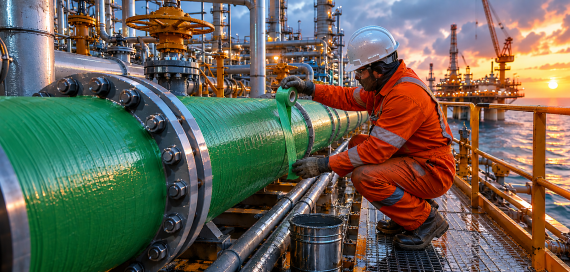
In harsh industrial environments such as offshore operations, steel manufacturing, mining, petrochemical plants, power generation, and oil & gas facilities, pipelines are among the most critical assets for operational continuity. These systems transport fluids, gases, slurry, steam, chemicals, and abrasive materials under extreme conditions of pressure, temperature, corrosion, and mechanical wear.
In this scenario, industrial epoxy resins have gained increasing importance as highly efficient technical solutions for protection, structural recovery, and life extension of pipelines and industrial equipment. In addition to enabling fast and safe interventions, modern epoxy systems reduce operational costs, minimize unplanned shutdowns, and significantly increase asset reliability.
The Role of Epoxy Resins in Industry
Epoxy resins are high-performance polymers designed to withstand severe operating conditions. Their industrial use has evolved rapidly over recent decades, especially in applications related to mechanical integrity and corrosion protection.
Today, they are widely used for:
In offshore and oil & gas industries, for example, epoxy resins are frequently applied in emergency repairs on process lines, seawater systems, subsea pipelines, and equipment exposed to accelerated corrosion caused by marine atmospheres.
In steel and mining industries, where abrasion, impact, and wear caused by solid particles are extremely common, epoxy compounds provide excellent mechanical and chemical resistance, significantly increasing asset durability.
Click the link below for more: Pipes Brochure
Main Problems Found in Industrial Pipelines
Regardless of the industrial segment, pipelines are constantly exposed to degradation mechanisms that compromise their integrity over time.
Among the most common problems are:
Corrosion
Corrosion remains one of the greatest challenges for industries worldwide. In offshore and petrochemical environments, the presence of humidity, salinity, aggressive gases, and chemicals dramatically accelerates corrosion processes.
The most frequent types include:
In many cases, damage remains hidden until leaks or critical failures occur.
Abrasion and Erosion
In mining and steel industries, solid particles transported at high velocity continuously wear down the internal walls of pipelines.
This phenomenon reduces wall thickness, weakens the structure, and increases the risk of rupture.
Leaks and Cracks
Excessive vibration, mechanical fatigue, high operating pressure, and material aging frequently generate cracks and leaks.
Besides financial losses, these problems may cause:
Failures Caused by Temperature and Chemical Attack
Sudden temperature variations and continuous exposure to aggressive chemicals can rapidly deteriorate conventional coatings and metallic materials.
For this reason, selecting the correct protection system is essential to ensure operational reliability.
Advantages of Using Epoxy Resins in Pipelines
Industrial epoxy solutions offer several technical and economic advantages compared to conventional repair methods.
Reduced Operational Downtime
Many epoxy systems allow repairs without requiring a complete plant shutdown, reducing production losses and operational impacts.
In sectors such as offshore and oil & gas, where every hour of downtime represents extremely high costs, this advantage becomes strategic.
Excellent Chemical Resistance
Epoxy resins provide high resistance against:
This ensures longer equipment lifespan and fewer maintenance interventions.
High Mechanical Resistance
Besides corrosion protection, modern epoxy systems also provide excellent resistance to abrasion, erosion, and mechanical impacts.
This characteristic is especially important in slurry pipelines, pumping systems, and mineral transportation lines.
Safer Application Process
Unlike hot welding repairs, many epoxy compounds can be applied without generating sparks or excessive heat.
This reduces operational risks in hazardous and classified areas.
Extended Asset Life
When correctly specified and applied, epoxy resins significantly contribute to extending the service life of industrial pipelines and equipment.
The result is a substantial reduction in replacement costs and emergency maintenance.
The Importance of Preventive, Predictive, and Corrective Maintenance
Pipeline integrity directly depends on the quality of maintenance strategies adopted by companies.
Preventive Maintenance
Preventive maintenance aims to avoid failures before they occur.
It includes:
This approach significantly reduces operational risks and increases production predictability.
Predictive Maintenance
Predictive maintenance uses advanced technologies to identify failures at early stages.
Among the most widely used techniques are:
These tools make it possible to strategically schedule interventions, reducing costs and preventing catastrophic failures.
Corrective Maintenance
When damage has already occurred, corrective maintenance becomes necessary to quickly restore operations.
In these cases, industrial epoxy systems stand out due to their fast application and ability to recover degraded structures with excellent mechanical performance.
Choosing the Right Epoxy Resin Makes All the Difference
One of the most common mistakes in industrial applications is using products that are not suitable for the actual operating conditions.
Each industrial environment has specific requirements related to:
For this reason, the correct specification of epoxy resin systems must be carried out by qualified professionals based on strict technical criteria and international integrity standards.
Furthermore, proper surface preparation is a critical factor for application success. Even the best epoxy system on the market may fail prematurely if the surface is not correctly prepared.
Technology and Integrity Working Together
Modern industries increasingly demand operational reliability, safety, and sustainability. In this context, industrial epoxy resins have become essential allies in the protection and recovery of critical pipelines and equipment.
When combined with efficient preventive, predictive, and corrective maintenance programs, these solutions directly contribute to:
Investing in advanced structural protection and recovery technologies is not only a maintenance matter — it is a strategic decision to ensure productivity, safety, and sustainability in today’s industrial landscape.
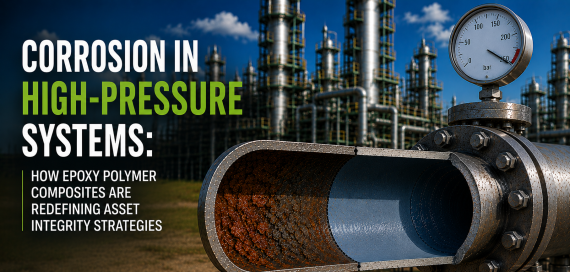
From offshore platforms and refineries to mining plants and gas processing facilities, pressure, chemical attack, erosion, and operational stress continue to compromise critical assets every day.
Read More

Epoxy polymer composite repair systems can restore and reinforce pipelines — but inspection is what ensures long-term performance. From engineering validation to regulatory compliance, inspection is the key to safety, reliability, and asset integrity.
Read More

 Back
Back
